Two Machines, One Site: How Load Handling Actually Gets Done on the Ground
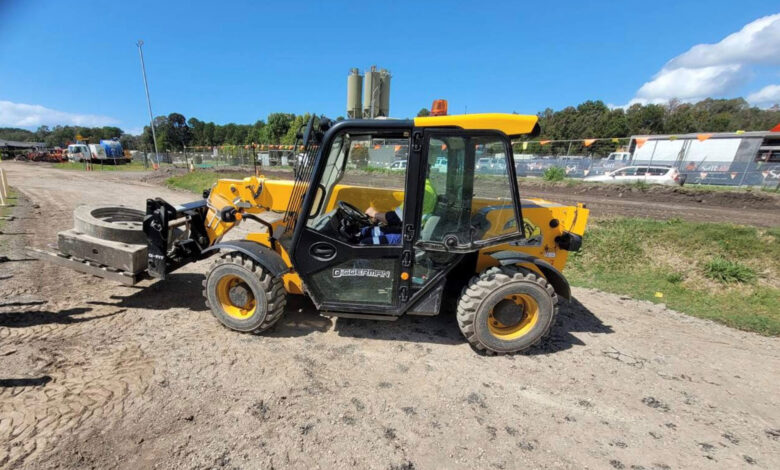
On a logistics yard outside Brisbane, a telehandler reverses out from between two rows of stacked steel beams, forks tilted back, load balanced against the machine’s telescopic boom. A few metres away, a mobile crane is mid-lift, easing a bundle of longer sections toward a trailer. Between the two machines stands a single worker, watching both — one hand raised toward the crane operator, eyes tracking the telehandler’s path as it clears the laydown area. Neither machine moves without that worker’s say-so, and neither operator seems to mind.
It is a small moment, easy to miss if you are not looking for it, but it captures something true about how material handling actually works on a busy Australian site. The machines get the headlines — the crane’s reach, the telehandler’s boom — but the coordination between them, and the person managing that coordination, is what keeps the whole operation from turning into a collision course.
The Person Reading the Load, Not Just Watching It
That worker standing between the two machines is a dogger, and the role exists precisely because operators cannot always see everything a lift requires. A crane operator watching a load swing toward a trailer may have no clear view of a telehandler reversing into the same laydown zone from the other direction. Someone on the ground needs to be tracking both, reading the whole picture, and issuing clear, immediate direction the moment two operations start to overlap.
Earning a dogman ticket means completing a five-day, fully practical course covering hazard identification and risk assessment, selecting and inspecting lifting gear, setting up the site and equipment correctly, slinging loads and directing crane movement by hand signal or radio, and safely shutting the job down at its end. There is no shortcut through classroom theory alone — assessors need to see a candidate manage an actual lift, under real site conditions, including the split-second judgment calls that come up when two pieces of moving equipment are working the same patch of ground at the same time.
The Machine Doing the Ground-Level Heavy Lifting
The telehandler working the other side of that yard is not incidental equipment either. With an extendable telescopic boom and interchangeable attachments — forks, buckets, grabs, work platforms — it covers ground that a standard forklift cannot reach and lifts loads a crane would be overkill for, making it one of the most heavily used machines across construction, warehousing, agriculture and mining sites nationally.
Operating one safely is covered by the nationally recognised conduct telescopic materials handler operations unit, RIIHAN309F, commonly known in the industry as the Gold Card. Delivered as a one-day course combining theory and hands-on assessment, it takes operators through planning and hazard management before a shift starts, pre-operational inspection of the machine and whatever attachment is fitted, safe load shifting and travel through obstacles, and a properly sequenced shutdown and site handover at the end of the job. Training extends beyond standard fork tynes to other common attachments, though it stops short of covering slewing telehandlers or crane jib attachments over three tonnes — those step up into separate high-risk licence territory entirely.
Where the Two Roles Genuinely Depend on Each Other
Watching a well-run yard for any length of time, the overlap between these two roles becomes obvious. A dogger directing a crane lift needs to know where every other moving machine on site actually is — and a telehandler, low to the ground and often working close to stacked materials, is exactly the kind of vehicle that can end up in a crane’s blind spot if nobody is tracking it. Equally, a telehandler operator manoeuvring near an active lift benefits enormously from a dogger who is watching the whole site rather than just the load directly overhead.
That interdependence is why experienced site supervisors rarely treat these as unrelated tickets held by unrelated crews. A yard where the dogger understands how a telehandler moves and where its blind spots sit — and where the telehandler operator understands what a raised hand from the dogger actually means mid-lift — runs with noticeably fewer near misses than one where each machine effectively operates in its own bubble. Training calendars on larger sites increasingly reflect that, scheduling dogging and telehandler competency close together so crews arrive with a shared operational vocabulary rather than two separate skill sets that happen to occupy the same yard.
Back on the Yard Floor
The lift finishes. The crane’s load settles onto the trailer, straps go on, and the dogger lowers his hand. Twenty metres away, the telehandler continues its run toward the next stack, clear now to move without the split-second hesitation it held a moment earlier. Nobody on site treats the pause as an inconvenience — it is simply how two machines and one set of trained eyes keep a busy yard from becoming a dangerous one.