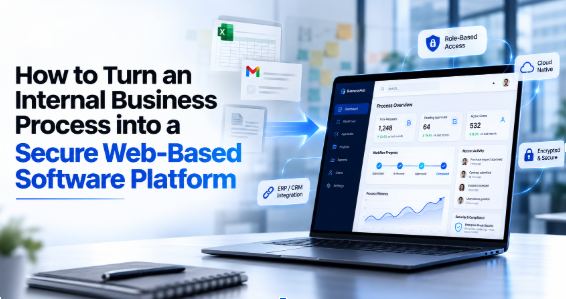
How to Turn an Internal Business Process into a Secure Web-Based Software Platform
Introduction: When Workarounds Become Liabilities
Most companies do not set out to build software. They set out to solve a problem. A spreadsheet gets created to track approvals. An email thread becomes the official record of client onboarding. For a while this works, because the team is small and everyone knows the unwritten rules.
Then growth arrives. Client volume multiplies, regulators ask harder questions, and the informal process begins to crack. Data lives in five places. Nobody is sure which version is current. Training a new hire takes weeks because the real process exists only in one person’s head.
This is usually the moment leadership teams start evaluating custom web application development services, not as a technology upgrade, but as a way to protect margins and reduce operational risk. Packaged tools are sometimes the right answer, but they ask your business to adopt someone else’s workflow. When your process is a genuine differentiator, that trade becomes expensive.
Enterprise-grade thinking matters because architectural decisions compound quietly. A platform built for fifty users can buckle at five hundred. A system without proper access controls becomes a liability the day you begin handling regulated data. Companies that treat custom software development services as a long-term capital investment tend to avoid the painful rebuild cycle that arrives three years later.
What Defines an Enterprise-Grade Application
The phrase gets used loosely. In practice it comes down to five characteristics.
Scalability. The system handles ten times the current load without a redesign. This is less about server capacity and more about whether you can add capacity where it is needed.
Security. Role-based access control, encryption in transit and at rest, audit logging, and secure authentication are baseline requirements. If your platform touches customer, financial, or health data, security architecture should be defined before the first line of code.
Performance. Slow internal tools do not just annoy employees. They erode productivity across thousands of daily interactions and push people back toward the spreadsheets you were replacing.
Reliability. Monitoring, automated backups, graceful failure handling, and a tested recovery plan. Uptime targets should be written down and measured, not assumed.
Integration capability. Your platform must exchange data with your ERP, CRM, accounting system, and identity provider. Clean APIs make future integrations routine instead of traumatic.
The Pillars That Support Long-Term Growth
Modular architecture. There is a persistent myth that microservices are automatically the modern choice. For many mid-sized businesses, a well-structured monolith is faster to build and easier to debug. The real requirement is modularity, meaning clear boundaries between functional areas so components can be replaced later without unravelling the system.
Cloud-native development. Building for the cloud is not the same as moving existing software to a cloud server. It means containerized workloads, infrastructure as code, automated deployment, and managed services. The payoff is elasticity during demand spikes and far lower maintenance overhead.
Multi-channel access. Internal processes rarely stay behind a desk. Field technicians, drivers, and site supervisors need the same workflow in their pocket. Planning early for Custom Mobile Application Development prevents the common outcome where a web platform succeeds internally, then requires expensive rework to serve people who are not sitting at a computer. A shared API layer serving both web and mobile clients keeps this straightforward.
Data as a first-class asset. Once a process moves into a structured platform, it generates clean, queryable data. Approval bottlenecks become visible. Cycle times become measurable. Design your data model with reporting in mind from day one, because retrofitting analytics onto a poor schema is expensive.
Common Mistakes
Treating development as a one-time expense. Software is a living asset. Budgeting for the build while ignoring maintenance and iteration guarantees the platform feels outdated within two years.
Deferring scalability. You do not need to build for a million users on day one. You do need to avoid decisions that make scaling impossible, such as tightly coupled components or business logic buried in the interface.
Digitizing a broken process. Automating inefficiency simply makes it faster. Fix the workflow before you encode it.
Best Practices
Map the process honestly first, including the informal shortcuts people actually use. Define success in business terms: approval time from four days to four hours, manual data entry down seventy percent.
Choose a development partner who challenges your assumptions. A vendor who agrees with everything in the first meeting is optimizing for the contract, not the outcome. Insist on source code access, documented architecture, and knowledge transfer.
Then release early and keep improving. Ship a focused first version that solves the single most painful part of the process, get it into real hands, and iterate.
A Practical Example
A mid-sized logistics firm managed freight claims through email and a shared spreadsheet. Forty claims moved through weekly, each requiring input from three departments. The average resolution took eleven days.
Replacing it with a web platform featuring role-based access, automated notifications, and a full audit trail cut resolution to under four days. More importantly, the reporting layer revealed that one carrier accounted for a disproportionate share of claims, a pattern invisible in the spreadsheet era. That insight drove a contract renegotiation worth more than the platform itself.
Conclusion
This is not primarily a technology decision. It is a decision about how much operational friction your organization is willing to carry as it grows, and whether your institutional knowledge lives in systems or in individuals.
The businesses that benefit most resist building the cheapest thing that works today. That approach costs more in year one and far less over five. If you are weighing this decision, the most valuable first step is an honest assessment of where your current processes will break, conducted before you commit to a build.